
Older homes have a charm that newer builds can’t match, but those creaky floors and thick walls sometimes lead to chilly corners and overheated rooms. Addressing uneven warmth requires more than simply adjusting your thermostat, and it necessitates thoughtful adjustments to ductwork, insulation, and system balancing.
Identifying Heat Loss Hotspots
When certain rooms feel chilly while others roast, you’re dealing with uneven heat loss. Older walls often lack modern insulation and leak warmth through tiny gaps around windows, doors, and electrical outlets. Walk through your home on a cold morning and run your hand along baseboards, window frames, and attic entries. You may feel cold air seeping in or spots where plaster feels unnaturally cool.
Those areas let your furnace’s warmth escape before it ever reaches living spaces. A professional can perform a thermal imaging scan to map where heat vanishes most rapidly. Armed with that map, you can prioritize adding insulation behind walls, swapping old single-pane windows for dual-pane models, or applying weather stripping. Filling those gaps reduces the burden on your heating system and brings a more consistent temperature from room to room.
Embracing Heating Zones and Smart Controls
Older single-thermostat setups treat your entire home as a single, large temperature bubble. That leaves rooms closest to the unit to hog most of the heat. Installing zoning dampers linked to multiple thermostats allows you to dial in different setpoints for distinct areas. You might keep the main suite at a cozy 72 degrees Fahrenheit while letting an unused guest room hover around 68 degrees.
Smart thermostats then learn your schedule and adjust automatically, directing heat only where and when you need it. That level of precision minimizes temperature differences and reduces wasted runtime. When you add motion sensors or smartphone controls, you can override settings on the fly if a rarely used nook suddenly needs warmth for a home office or hobby room.
Refreshing Aging Equipment
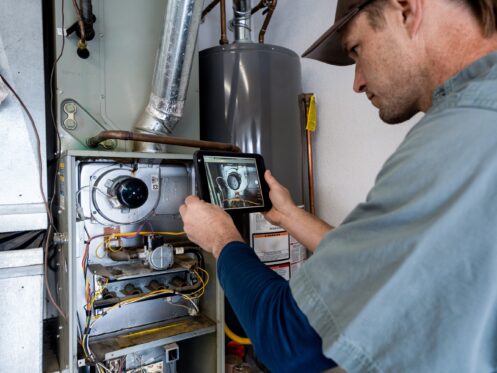
Furnaces and boilers older than 15 years often lose efficiency and struggle to maintain a steady output. Scale buildup on heat exchangers or burner orifice erosion can make flames flicker irregularly, starving your system of steady heat. A comprehensive service visit cleans the combustion chamber, swaps out clogged nozzles, and realigns the burner assembly for full, even ignition.
Technicians also check safety limits and test the heat exchanger for cracks that let cold air mix with warm. When your heating unit operates smoothly, it pumps out the right amount of heat rather than surging and settling. That continuous operation keeps temperatures from swinging wildly and stops that yo-yo feeling where rooms shift from warm to cold as the system cycles.
Bleeding Radiators and Baseboard Units
Homes with hot-water radiators or baseboard heat can develop cold pockets from trapped air. Those airlocks prevent heated water from filling the entire radiator, leaving one end to sit cool. To tackle that, attach a small wrench to the bleed valve at the radiator’s top and gently open it until water dribbles out.
Hearing a hiss gives way to a steady stream of signals that the trapped air has escaped. After you close the valve, the unit warms evenly from end to end. If a baseboard runs on multiple loops, you may need to balance flow by tightening or loosening valve handles at each loop’s start. A balanced hydronic system feels to your body like a soft blanket of warmth, not a patchy quilt.
Boosting Local Comfort With Supplemental Heaters
Even the best duct corrections can leave far-off corners a touch cooler. Strategically placing infrared panels or electric baseboard units in those trouble spots delivers instant warmth right where you feel it. Infrared heaters mounted on walls cast heat that warms furniture and feet directly, rather than heating the entire air volume.
You might install a small radiant panel under a workbench or behind a favorite reading chair. Those local units must be hardwired by a pro to meet code, and they include built-in thermostats to switch off once that microzone reaches your set temperature. With these supplements, you gain precise control over each area’s comfort without cranking up the central system.
Sealing Attic and Crawlspace Leaks
Your home breathes through its envelope, and gaps under floorboards or around attic hatches let conditioned air vanish into unheated voids. Crawlspaces with open vents dump heat under the house, chilling pipes and joists above them. Blocking those vents and adding rigid foam board under the subfloor closes off an entire sink of cold air underfoot.
In the attic, you can install an insulated stair cover or weather-strip attic doors to form a tighter seal overhead. Air barrier paint on rim joists and around vent penetrations stops drafts where framing meets drywall. Once your envelope behaves like a sealed box, the warmth you pay to generate stays put inside the living areas.
Calculating the Right System Capacity
Older homes may have had add-on heating units installed long ago but failed to match them to current square footage or insulation levels. An undersized system runs constantly but never reaches setpoints evenly, while an oversized unit short-cycles, blasts heat, and shuts down prematurely. A professional heat-load calculation measures your home’s orientation, window area, insulation quality, and air tightness.
Those numbers reveal the precise output needed in British thermal units. Armed with that, you can select a replacement furnace or boiler, and any supplemental heaters, with the correct capacity to run smooth cycles. That tailored sizing eliminates bouts of overheating near the unit and underheating in distant rooms, bringing a gentle consistency to every corner of your home.
Consider Professional Airflow Testing
When you’ve tried every tweak and still find stubborn hot or cold pockets, experts can bring specialized testers to measure cubic feet per minute at each register. They record how much air arrives compared to design specifications. If a branch runs short, technicians may upsized ducts or add a booster fan inline to push more air through that branch.
They can also remove sections of existing ductwork to smooth out twists and sharp elbows, replacing them with straighter runs that promote flow. Following this data-driven approach provides you with hard numbers instead of guesswork, and those adjustments fine-tune your system’s balance so that every room receives just the right amount of comfortable air.
Embracing Year-Round Comfort
After you level out heating, you’ll find that the same principles improve summer cooling too. Sealed ducts, smart zoning, and a tight building envelope reduce humid, overheated areas in summer and cold spots in winter. Schedule spring duct cleaning and fall HVAC tuning so that every component works in harmony through each season. Keeping filters fresh, motors oiled, and coils clean maintains airflow and temperature control, no matter the weather outside.
Keep Your Home Comfortable No Matter What
From zoning upgrades to targeted duct sealing and airflow tuning, we cover every angle to smooth out those temperature swings. We also handle filter swaps, thermostat calibration, and insulation improvements that directly boost your home’s heating performance. Give Southern Pride Service in White Plains, MD, a call today to schedule your custom heating assessment.